
A Shepherd’s Roadmap for Thriving in the Age of AI
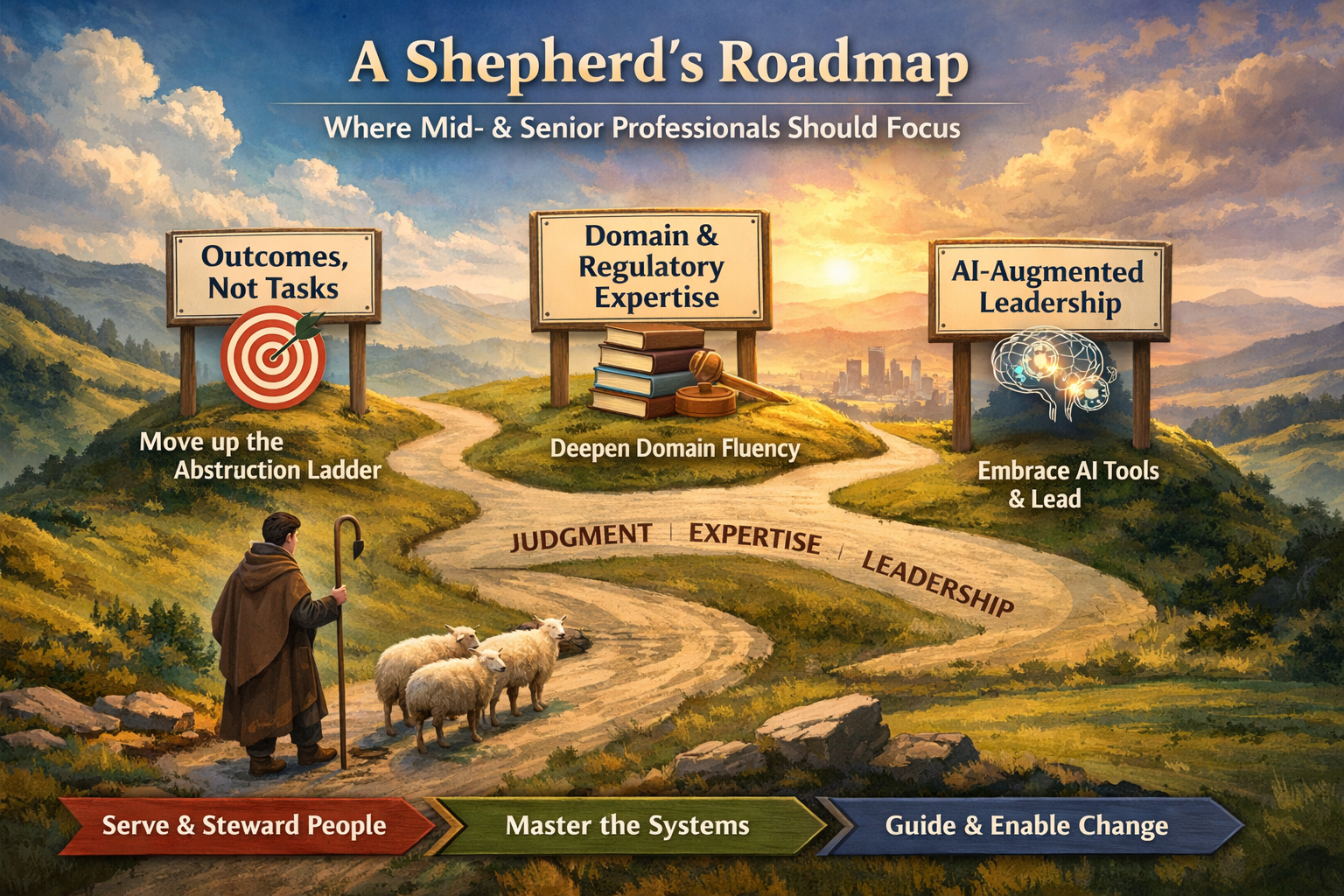
Image generated from DALE 3.0
As a mid-career or beyond, you’re likely watching the rising tide of AI with unease: headlines threaten “hundreds of millions of jobs exposed” to automation, prompting a very human question: Am I next? Our anxiety feels real — especially in regulated sectors like financial services, where compliance, governance, and complexity already consume a significant portion of our time.
However, a closer look at the research reveals a more nuanced—and encouraging picture. A 2023 report by the McKinsey Global Institute (MGI) estimates that as generative AI ramps up, about 30% of hours worked in the U.S. economy today could be automated by 2030.
Likewise, the World Economic Forum (WEF), in its 2025 labor outlook, predicts widespread skill-shifts and job disruption — yet also substantial job creation.
In short: tasks will be reshaped, not people; roles will evolve, not vanish.
What AI Is Likely to Absorb and What It Won’t
Where automation is initially adopted
For project, portfolio, and product professionals, the most vulnerable tasks are routine, repetitive, or predictable: schedule updates; compliance reports; dashboard generation; status emails; basic forecasting; spreadsheet maintenance. Many of these are already being handled, or soon will be, by AI-driven tools.
Indeed, AI-powered project and portfolio tools are already automating elements such as performance tracking, compliance reporting, and early-warning signals around budget, schedule, or scope risk. This shift frees human leaders from “spreadsheet survival,” enabling richer focus on strategic and relational work.
But even the most advanced “AI project management” products remain what they are: automation, not true intelligence. They may speed up coordination — but they cannot (yet) replicate human judgment, political sensitivity, regulatory nuance, culture, or trust.
What’s unlikely to be automated right away
Today I’m seeing AI struggle with holding strategic context for trade-offs, cross‑organizational decisions, and prioritization across risk and reward—especially where regulatory interpretation, compliance, ambiguity, or conflicting objectives are involved. Expect that to change quickly.
Systems thinking & enterprise context (seeing how products, data flows, regulations, and risk interconnect across the firm). Valuable especially in complex, regulated environments like financial services. Human leadership, influence, empathy, trust, change-management, team development can’t coach, build psychological safety, resolve conflict, or shepherd people — but human leaders can.
Domain and regulatory fluency
Experts who deeply understand financial regulation, risk frameworks, audit trails, compliance, and can translate that into action remain essential for literacy and orchestration. Knowing AI strengths and limits, designing workflows where AI handles routine tasks, and humans manage exceptions & decisions, and evaluating AI output critically.
For now, as AI automates the routine, the premium swings to those who can interpret, decide, lead, and steward.
Which Roles Are Likely to Shrink and Which Will Grow
Roles that are narrow and process-oriented — especially full-time “process police” roles are most exposed:
Dedicated transformation consultants or agile coaches whose value mainly lies in implementing frameworks and ceremonies. Once new workflows are embedded, often AI-enabled demand for these roles tends to shrink.
Full-time Scrum Masters or process-only project managers whose work is mostly scheduling, status chasing, updates, and coordination.
Administrative or process-heavy project functions count on manual coordination, reporting, and compliance tracking.
To the contrary, demand is likely to grow, especially in regulated sectors such as finance, for roles that require judgment, context, and human leadership:
Strategic portfolio managers and value-stream leaders need to pivot from capacity gatekeepers to investment strategists, interpreting AI insights in light of regulatory, cultural, and operational realities.
Senior project or program leaders (RTE/TPMs) — orchestration, roadmap translation, delivery across complex value streams, especially where legacy systems, compliance, and risk coexist with new AI-enabled processes.
Enterprise and solution architects who envision future-state architectures while balancing legacy constraints and regulatory risk.
AI governance, risk, and compliance leaders who are accountable for how AI is used, audited, interpreted, and explained within strict regulatory and risk frameworks.
This shift aligns with broader labor-market predictions. The WEF identifies demand increasing sharply for roles such as big data specialists, fintech engineers, cybersecurity experts, and other tech-heavy but strategic functions.
At the same time, jobs that rely heavily on routine administrative or clerical tasks. For example, clerks, data-entry roles, bank tellers, and secretarial work are projected to decline most rapidly.
Where Mid- and Senior Professionals Should Focus: A Shepherd’s Roadmap
To stay relevant and thrive as AI grows in finance, make three strategic moves that reflect shepherd leadership: serve people, manage systems, guide change, and unlock potential.
1. Move up the abstraction ladder — from tasks to outcomes
Shift perspective: rather than managing the mechanics (e.g., “update the portfolio process,” “run the sprint schedule”), take ownership of outcomes: maximizing value, minimizing risk, aligning with business strategy. Use AI-generated insights as input, then apply your judgment to make decisions that executives and stakeholders can trust.
2. Deepen domain & regulatory fluency
In regulated industries, compliance, auditability, governance, controls, and risk frameworks matter. The more you understand products, markets, regulations, and risk frameworks, the harder it becomes to replace your role with a “generic AI manager.” Your value becomes anchored in human judgment applied to real-world complexity.
3. Become an AI-augmented servant leader — not an AI refugee
Start using AI tools today to automate your own low-value work (e.g., draft status reports, generate first-pass risk logs, and automated summaries). That frees your time and focus for the higher-level leadership work where you add unique value.
At the same time, invest time to understand AI’s capabilities and limitations. Ask tough questions when vendors promise the moon; shape adoption in a way that respects regulatory constraints, risk, compliance, and ethical stewardship.
As firms adopt AI, they don’t just need “AI-savvy managers.” They need shepherds.
Shepherd Leadership: Why the Human Touch Matters More Than Ever
Your background and values — shaped by a servant-leadership mindset — uniquely prepare you for this moment. As firms adopt AI, they don’t just need “AI-savvy managers.” They need shepherds: leaders who view their role as serving people, guiding change, building trust, and stewarding not just processes — but culture, meaning, and purpose.
Empathy & Compassion: As teams adjust to AI-driven workflows, there will be fear, resistance, and uncertainty. Leaders who lead with empathy, listen, care, and help people navigate change will earn trust and foster resilience.
Guidance & Support: AI may speed up tasks, but it won’t offer vision, context, or values. Shepherd-leaders provide coaching, mentorship, and direction. They help people see not only how to work differently, but why.
Humility & Service: In a world of accelerating change, no one has all the answers. Effective leaders stay humble, open to learning, willing to question assumptions, and to serve the good of the organization and community.
Stewardship & Integrity: Especially in financial services, stewardship means balancing innovation with compliance, progress with risk, efficiency with ethics. That’s exactly the domain where human judgment — guided by values — matters most.
By embracing AI not as a rival, but as a tool under your stewardship, you help shape not just what gets done — but how it gets done, and why it matters.
A Realistic, Encouraging Conclusion
The strongest data we have does not support a simplistic doom-and-gloom narrative in which all project and portfolio leadership jobs are eliminated. Instead, what we see is deeper nuance: a transformation in what roles we do, and which roles thrive.
Yes. A large share of tasks will be automated or reshaped. Some roles, especially those built around routine and administrative work, may shrink or disappear. But for those willing to adapt: those who combine systems thinking, domain mastery, human judgment, and shepherd-style leadership — new opportunities for more meaningful, strategic, impactful work will emerge.
In that sense, AI is not a wrecking ball; it’s an amplifier. It will expose where our roles were built on routine, and it will reward those who bring human judgment, purpose, empathy, and strategic vision.
If you are mid-career or senior, you are not “too late.” You are being called to a different kind of leadership. With humility, service, and intentionality, embracing AI not as adversary, but as a powerful set of tools under your stewardship, this is not just a time to survive: it’s a time to lead.